

[New] SPS: Introduction to Logistics and Fulfillment Score


AI Summary
The logistics & fulfillment score now prioritizes faster delivery over on-time delivery, combining dispatch time, transit time, seller-fault cancellations, and a free shipping bonus of +0.5 when coverage meets category thresholds. It applies within each seller’s category, with special handling for FBT/4PL/CBT, custom orders, LTL, and cross-border orders. New-version scores are preview-only during trial; appeals for logistics metrics are scheduled to roll out in batches from 10/19 to 10/26.

- How is each metric calculated?
- How to Check the Logistics & Fulfillment Score? → Feature Guide
- Whether appeals are supported? → How to Appeal
What Is the Logistics & Fulfillment Score?
- Timeliness: broken down into clearer, more attributable, and more improvable stages — Dispatch Time and Transit Time;
- Fulfillment service: Seller Fault Cancellation Rate is retained, and Free Shipping Coverage is added as a bonus metric.
- Scoring metric: included in weight allocation
- Bonus metric: add points directly when standards are met
Metric-V7 | Time window | Definition | Metric type |
Dispatch Time | 30D | The average time it takes for orders to move from "Awaiting shipment" to "In Transit" status over the last 30 days. | Scoring metric |
Transit Time | 30D | The average time it takes for orders to move from "In Transit" to "Delivered" status over the last 30 days. | Scoring metric |
Free Shipping Coverage | 7D | The proportion of free shipping orders among all delivered orders in the last 7 days. | Bonus metric |
Seller Fault Cancellation Rate (SFCR) | 30D (T-14, T-44) | The percentage of placed orders canceled because of a seller fault over the past 30 days (T-14, T-44). - Excludes orders related to FBT logistics | Scoring metric |
How to Calculate Logistics & Fulfillment Score?
Calculation Formula
Free Shipping Coverage is a bonus metric and is not included in weight allocation. When Free Shipping Coverage reaches the bonus threshold, an additional 0.5 points will be added to the dimension score, capped at a maximum of 5 points.
#Step 1: Metric Calculation

- A seller's performance is only compared with shops under the same calculation category.
- Shop calculation category: determined by whether a category accounts for ≥60% of the seller’s order share or GMV share over the past 90 days.
- Oversize items category split: Given their higher logistics and fulfillment complexity, sellers primarily selling oversize items are placed in a separate calculation category based on the logistics-side oversize definition.
[New] Dispatch Time
Dispatch Time = Total Dispatch Time / Total OrdersTotal Dispatch Time: Over the past 30 days, the total time for all delivered orders to move from "Awaiting shipment" to "In transit" status, in hoursTotal Orders: Over the past 30 days, the number of all delivered orders- Orders using Seller Shipping (3PL) & orders using Standard Delivery (4PL) / Collection by TikTok (CBT)that are classified as seller-responsible
- Standard calculation
Example: Over the past 30 days, the seller delivered 10 orders in total, all using the 3PL service, with a total dispatch time of 300 hours.
- Shop Dispatch Time = 300 hours / 10 orders = 30 hours
- Orders using Fulfilled by TikTok (FBT) & orders using Standard Delivery (4PL) / Collection by TikTok (CBT) that are not seller-responsible
- The platform is responsible for collection. To avoid collection timeouts caused by force majeure, the platform calculates it based on the standard for each logistics service within the same calculation category.
- The reference standards for Dispatch Time under each logistics service are listed below:
Logistics Service | FBT, Fulfilled by TikTok | CBT, Collection by TikTok | 4PL, Standard Delivery | 3PL, Seller Shipping | ||
not seller-fault | seller-fault | not seller-fault | seller-fault | |||
Reference Standard | Dispatch time for the 5-point standard in the same category | Dispatch time for the 4.5-point standard in the same category | Standard calculation | Dispatch time for the 4-point standard in the same category | Standard calculation | Standard calculation |
For more information about the platform's logistics services, please go to: Logistics Overview and Seller Center NavigationExample: The shop's calculation category is Womenswear. Over the past 30 days, orders A and B were delivered, both using the FBT service; The reference Dispatch Time corresponding to the 5-point standard for Womenswear is 15 hours.Order A's actual dispatch time = 18 hours > 15 hours; Order B's actual dispatch time = 10 hours < 15 hours;
- Thus: Dispatch Time (Order A) = 15 hours, Dispatch Time (Order B) = 10 hours
- Shop Dispatch Time = (15+10) hours / 2 orders = 12.5 hours
*Data is for illustration only and does not represent actual conditions
- Custom Order: Back-order (BO), Make to Order (MTO), Pre-order (PO)
- Sellers may use fulfillment tools to extend dispatch for custom products, pre-sales, or temporary order surges.
- Back-order: the platform calculates related orders based on the 3.5-point standard for Dispatch Time in the same calculation category, regardless of logistics services.
- Make to Order / Pre-order: Related orders are excluded from Dispatch Time assessment.
[New] Transit Time
Transit Time = Total Transit Time / Total OrdersTotal Transit Time: Over the past 30 days, the total time for all delivered orders to move from "In-transit" to "Delivered" status, in hoursTotal Orders: Over the past 30 days, the number of all delivered orders- Seller Shipping (3PL)
- Standard calculation
- Standard Delivery (4PL), Fulfilled by TikTok (FBT), Collection by TikTok (CBT)
- The platform is responsible for collection. To avoid collection timeouts caused by force majeure, the platform calculates it based on the standard for each logistics service within the same calculation category.
- The reference standards for Transit Time under each logistics service are listed below:
Logistics Service | FBT, Fulfilled by TikTok | CBT, Collection by TikTok | 4PL, Standard Delivery | 3PL, Seller Shipping |
Reference Standard | Dispatch time for the 5-point standard in the same category | Dispatch time for the 4.5-point standard in the same category | Dispatch time for the 4-point standard in the same category | Standard calculation |
Example: The shop's calculation category is Menswear. Over the past 30 days, orders A and B were delivered, both using the 4PL service; The reference Transit Time corresponding to the 4-point standard for Menswear is 85 hours.Order A's actual transit time = 100 hours > 85 hours; Order B's actual transit time = 80 hours < 85 hours;
- Thus: Transit Time (Order A) = 85 hours, Transit Time (Order B) = 80 hours
- Shop Transit Time = (85+80) hours / 2 orders = 82.5 hours
*Data is for illustration only and does not represent actual conditions
[New] Free Shipping Coverage (Bonus metric)
- Free Shipping Coverage = Delivered orders with $0 paid shipping fee / Total delivered orders in the past 7 days
- Default bonus threshold: When Free Shipping Coverage ≥ 80% → +0.5 to the dimension score, capped at 5.
- Special bonus threshold: For categories with lower AOV and greater difficulty in offering free shipping, the threshold is lowered to 60%. When Free Shipping Coverage ≥ 60% → +0.5 to the dimension score, capped at 5.
- [Updated on 10/16] Applies to the following 12 categories: Collectibles, Non-natural Crystal, Non-sports Trading Cards, Sports Trading Cards, Food & Beverages, Fashion Accessories, Trading Cards & Accessories, Books, Magazines & Audio, DIY, Hair Accessories, Automotive & Motorcycle, Computers & Office Equipment
- [Updated on 10/16] Auction orders are excluded from the free shipping rate calculation.
[No Change] Seller Fault Cancellation Rate
- Seller Fault Cancellation Rate (SFCR) = Number of orders canceled due to seller's fault / Number of all orders in the To Ship - Awaiting Shipment stage in that period
- Includes cancellations handled by the platform and 4PL;
- Orders related to FBT are excluded from the numerator but included in the denominator.
#Step 2: Convert Metrics into Scores
- Metrics are scored from 0 to 5, with standards set for 1–4 points.
- Metrics are converted based on the score standards within the same shop calculation category.
- Meeting a score threshold earns at least that score; better performance earns a higher score.

ExampleShop A and B both have Kids' Fashion as their calculation category. For the Kids' Fashion, the 3-point standard for Dispatch Time is 48 hours, and the 4-point standard is 40 hours. Shop A’s and Shop B’s dispatch times over the past 30 days are 40 hours and 41 hours, respectively.
- Shop A’s dispatch time score is exactly 4 points, while Shop B’s dispatch time score falls within the 3–4 point range.
- Based on Shop B’s dispatch time ranking within the Kids' Fashion category, Shop B’s dispatch time score is calculated as 3.9 points.
*Data is for illustration only and does not reflect actual scoring standards.
#Step 3: Derive the Final Score

- Different metrics impact consumer experience differently, so Logistics & Fulfillment metric scores are weighted when aggregated.
- Weights vary by the seller’s main category.
- Free Shipping Coverage is a bonus item: it does not receive weight. When Free Shipping Coverage reaches the bonus threshold, an additional 0.5 points will be added to the dimension score, capped at a maximum of 5 points.
[Special Scenarios]
- Excluded from both Dispatch Time and Transit Time calculations, including numerator and denominator.
- Excluded from Transit Time calculations, including numerator and denominator.
Special scenario calculationExample: If a seller delivered 10 orders in the past 30 days and 4 are LTL orders, only the remaining 6 orders are used to calculate average Dispatch Time and Transit Time.
How to Appeal?
- New Version:
- During the new-version trial run: New Version scores are for preview only; related scores and benefits do not take effect, so appeals are not supported yet.
- After the official launch: Appeals will open gradually after launch, expected in October. If you dispute an order’s calculation, submit an appeal via the appeal entry.
- Product Satisfaction / Customer Service metrics appeals: Available from 10/16. The appeal entry point is generally the same as in the previous version.
- Logistics & Fulfillment metrics appeals: Expected to open to sellers in batches starting 10/19, and to all sellers by 10/26.
- Old Version: All appeal functions in the current version operate normally. For specific appeal methods, please go to: How to Appeal Your Shop Performance Score (SPS) Metrics
Feature Guide: How to Check the Logistics & Fulfillment Score?
Step | Module & Function | Product UI & Details |
Step 1: Understand overall performance | [Logistics & Fulfillment Score Overview] View the overall logistics & fulfillment performance and benefits | V7 adds dimension-level benefits: traffic incentives configured for the shop; the exact thresholds and incentive levels are subject to the version at launch.  |
[Suggested Score-Improvement Actions]
|  | |
Step 2: View score calculation details | [Score Calculation Formula] Understand each metric’s impact on the final score, including:
|   |
Step 2: View score calculation details | If you have any questions about the metric definitions and calculations, focus on this module ❗️ [Metric Details]Click the button on each metric card to view:
|  Click the button on the metric card to view the metric definition and why it is at this performance level. ↓ 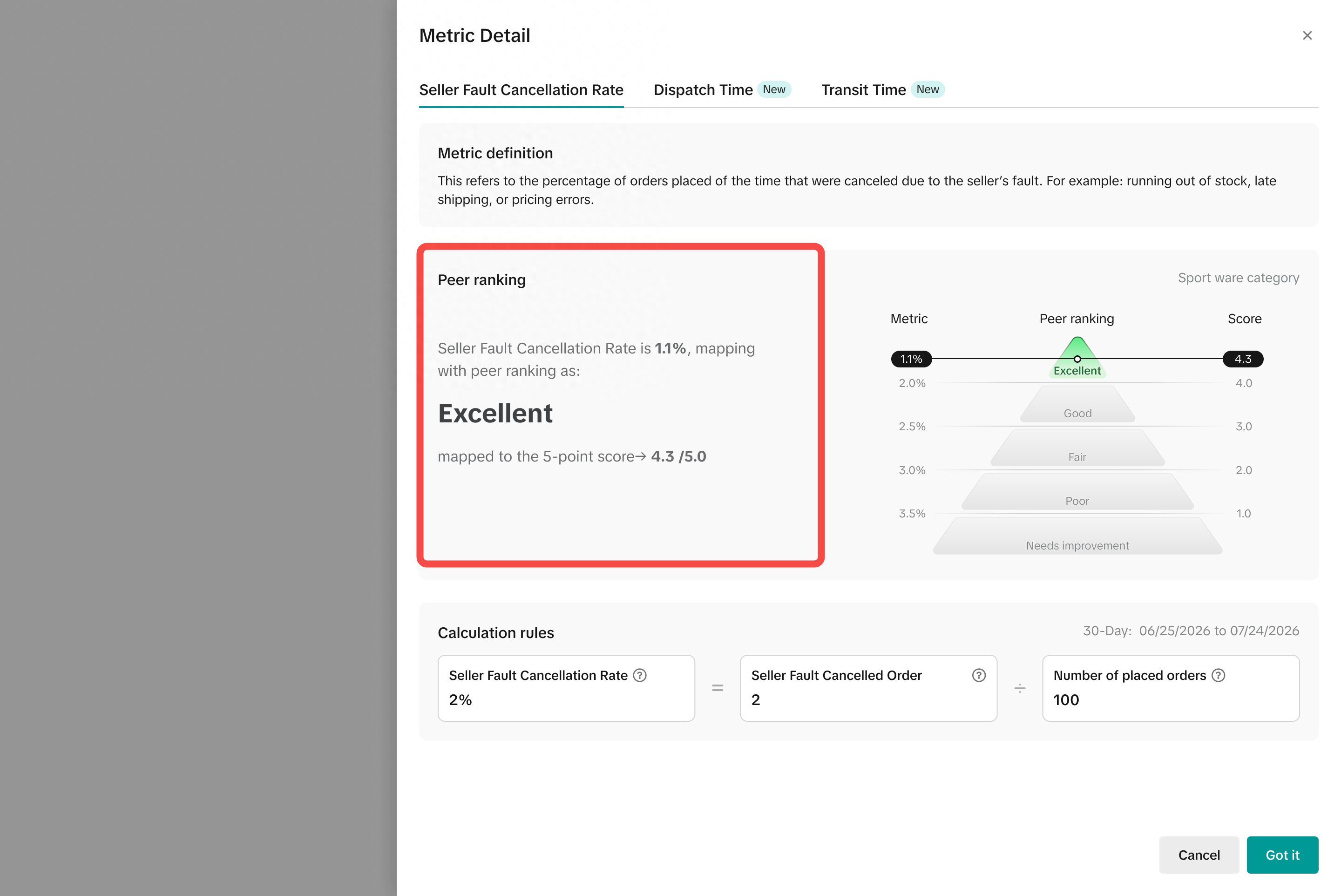 |
Step 3: Identify issue metrics | [Metric Card] View each metric’s performance level:
| Click / switch between different metric cards → view the specific metric analysis  |
Step 4: Identify issue orders | [Problem Order Details] View and export order details included in the metric calculation. |
 |
FAQ
Why does my Logistics & Fulfillment page look different from other sellers' ?
The fulfillment module is being upgraded and rolled out in phases, so sellers may see different page versions.Please rest assured, this does not affect scoring: all sellers follow the same Fulfillment score calculation rules and standards. No action is required; please stay tuned for follow-up platform notifications.
How are oversize item categories split?
Items hitting the following L1 categories should not be considered oversize: Fashion Accessories, Modest Fashion, Kids' Fashion, Shoes, Menswear & Underwear, Pre-Owned, Collectibles, Womenswear & Underwear, Jewelry Accessories & Derivatives, Virtual Products, Books, Magazines & Audio, Food & Beverages.
V7 includes 9 oversize items categories in total, subject to volume requirements:
- L1: Furniture
- L2: Indoor Furniture, Outdoor Furniture
- L3: Mattresses, Sofas, Scooters Equipment, Cycling, Ride-on Toys, Power Supplies
If a shop uses multiple logistics services, how are Dispatch Time or Transit Time calculated?
Example uses Dispatch Time; Transit Time follows the same logic.In the past 30 days, the seller delivered two orders:
- Order A: FBT, actual dispatch time 18h. Dispatch Time corresponding to the 5-point standard for the seller’s calculation category is 15h. Thus, dispatch time for order A is 15h.
- Order B: Seller Shipping (3PL), actual dispatch time 10h, calculated normally.
Shop Dispatch Time = (15h + 10h) / 2 = 12.5h*Data is for illustration only and does not represent actual conditions.
How are combined or split packages calculated?
You may also be interested in

AI Homepage: Reinventing the TikTok Shop Seller Experience
What is the AI Homepage? The AI Homepage isn’t just a new dashboard, it’s a game-changing, AI-powere…

[New] Introduction to Shop Performance Score New Version (US…
Quick Navigation: Where should you start? Protection Strategy for BFCM → How will SPS metric scores…

[New] SPS: Introduction to Product Quality Score
Quick Navigation: Where should you start? Product Quality Score calculation steps → How is product q…

[NEW] Guide to VoC (Voice of Customer)
What is VoC? Voice of Customer (VoC) is a seller-facing analytical tool that helps you find, underst…