

Non-Buyer Fault Return & Refund Rate (NBFR) Requirements

Key Points:This document outlines the requirements and provides information for the Non-Buyer Fault Return and Refund Rate (NBFR) on TikTok Shop. NBFR is also subject to our Fulfillment Policy and Order Cancellation, Return, and Refund Policy. Sellers must comply with this document, the Fulfillment Policy, and the Order Cancellation, Return, and Refund Policy when fulfilling orders and managing return and refund requests on our platform.
- Non-Buyer Fault Return and Refund Rate (NBFR) is the percentage of delivered orders that had return or refund requests due to seller- or logistics carrier-fault.
- NBFR evaluates the past 60 days of orders.
- Non-Buyer Fault Return and Refund Rate will be included in your overall Shop Performance Score (SPS)—alongside other measures of product satisfaction, logistics and fulfillment, and customer service.
- You can check NBFR performance on your Shop Performance Score (SPS) page in Seller Center.
Non-Buyer Fault Return and Refund Rate (NBFR)
The purpose of the Non-Buyer Fault Return and Refund Rate (NBFR) is to provide sellers with insight on how often after-sales issues (returns and refunds) arise due to seller-fault or logistics carrier-fault reasons.By regularly checking the NBFR, a seller can:
- Understand how satisfied buyers are with their orders, even without written reviews or chat feedback.
- Identify operational gaps in your shop or with your logistics partners.
NBFR Return and Refund Reasons
When customers request a return and/or refund, it means that they are unsatisfied with the product or condition that the product was delivered in.Returns and refund reasons that count towards your NBFR can be broken up into two categories.
Product Issues: The below issues are the most common NBFR return and refund reasons due to the product.
- Product functionality (not working, missing parts)
- Product condition (damaged)
- Product expectations (not as described)
- Order delivered but not received
- Delayed delivery
Exceptions for Non-Buyer Fault Return and Refund Rate
There are a few scenarios that are excluded from NBFR calculations.- Logistics issues for orders through the Fulfilled by TikTok (FBT) program
- Canceled orders (before delivery) by either seller or customer

Please note: TikTok Shop reserves the right to update this responsibility assignment at any time to reflect changes in our services or operational processes.
How Non-Buyer Return and Refund Rate is Calculated
Non-Buyer Return and Refund Rate is the percentage of delivered orders in the last 60 days that led to a refund or return request from the customer due to seller- or logistics-related issues. Number of delivered orders returned or refunded due to a seller or logistics partner fault ÷ Total number of delivered orders without cancellations. Multiply that number by 100.Example ScenarioShop ABC received 3 return requests—due to non-buyer fault issues—out of 10 delivered orders in the past 60 days. To calculate the NBFR, the following steps can be followed:
- (3 ÷ 10) = .3
- .3 x 10 = 30
- NBFR = 30%
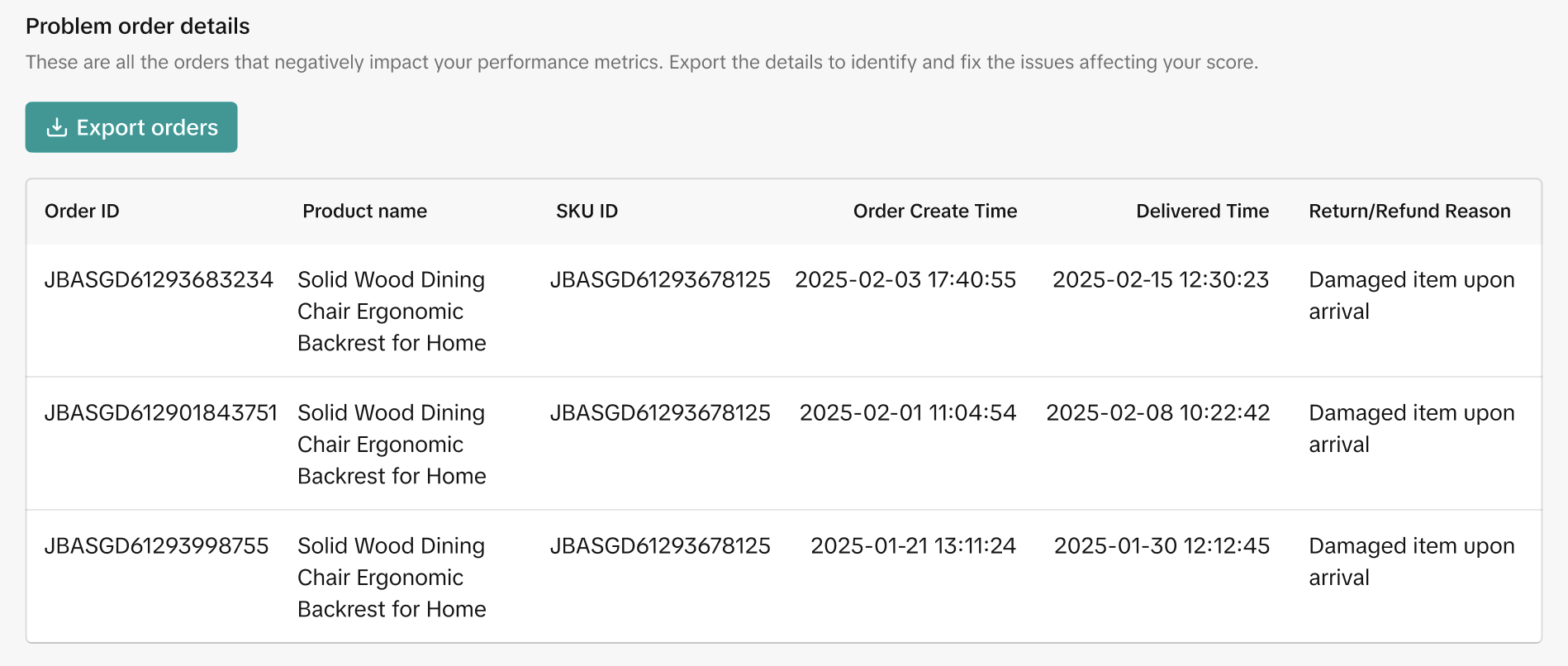
A shop's Non-Buyer Return and Refund Rate refreshes daily and is published in Seller Center.
How Non-Buyer Fault Return and Refund Rate Impacts Your Shop
Your Non-Buyer Fault Return and Refund (NBFR) rate directly affects your shop’s performance. NBFR is a key factor in calculating your Shop Performance Score (SPS).- A high NBFR can negatively affect your SPS, which may reduce product visibility and affect your eligibility for SPS benefits.
- A low NBFR can improve your SPS and positively impact your eligibility for SPS benefits.
If you have concerns about your NBFR, you can reach out to your Account Manager or request support through Seller Center.
Non-Buyer Return and Refund Rate is one of six metrics contributing to your Shop Performance Score. Find out more about another Shop Performance Score metric that evaluates after-sales requests: After-Sales Handling Time.Learn more about the other metrics in our 2025 Guide to Shop Performance Score.