

Best Practices for Promotional Content
10/25/2025
Key Points:
- Ensure that the product that you are promoting matches the listed product.
- When stitching or dueting videos, always add your own edits or commentary to keep the content original.
- Don't repost your own content.
- Comply with intellectual property laws by avoiding the use of copyrighted material or promoting counterfeits and knockoffs.
Promotional Content on TikTok Shop
On TikTok Shop, customers rely on content such as product photographs, videos, and descriptions to make their shopping decisions.As a creator, it's your chance to make an impression. Keeping your promotional content accurate, relevant, and original not only builds trust with your viewers but also helps your content to stand out and thrive.
Click on the navigation bar on the right for detailed guidelines on how to:
- Promote Products Accurately
- Post Original and Creative Content
- Respect Others' Privacy & Intellectual Property (IP) Rights
Promote Products Accurately
 Accurate and relevant promotional content enhances your engagement with customers and builds their confidence to make informed purchase decisions.
Watch the video below to dive deeper into the details!
Best Practices ✅
- Incorporate informative visual or verbal elements in your content to make the product the focus.
- Visual elements to include:
- Show how to use the product in a real-time demonstration.
- Present the product from multiple angles and highlight its key details.
- Show how the product is made.
- Showcase the packing of orders.
- Verbal elements to include:
- Share about the product's size, weight, dimensions, color, scent, etc.
- Explain the product's features and how to use it.
- Describe the product content or ingredients.
- Share the inspiration behind the product, its design, cultural reference, or brand story.
- Discuss the price and mention any available discounts or deals.
- Include details about shipping methods, prices, and delivery times.
- Share your personal review and any relevant stories about the product.
- Explain how the product is made.
- Visual elements to include:
- When featuring a product in your video or livestream, make sure the promoted product matches the listed product.
- Products match when they share the same physical type and shape.
- Products also match even if they differ in color.
- Products don't match if they differ in size, weight, pattern, quantity, graphics, logo, image, or print.
- Showcasing sample products that differ in size, weight, or quantity from the listed product must be accompanied by a clear disclaimer stating that the item shown in the content is a sample size and it does not include all the products in the listing.
- When featuring makeup or skincare products, you may choose not to showcase the product itself in your content if it has been visibly applied to your face or body. Ensure that your viewers can clearly see the effects of the product on your skin!
- Use text, descriptions, or titles of your livestream or video to accurately describe the product you are promoting.
What to Avoid 🚫
Avoid irrelevant promotions and inconsistent product promotion, where the promotional content does not match or accurately describe the listed product.- Avoid hosting a livestream without featuring the promoted product.
- If you're showcasing a makeup or skincare product, it's okay to not show the product itself as long as it's clearly applied to your face or body.
- Avoid leaving out important visual and verbal information about the product.
- Avoid using stock footage or illustrated images that do not accurately represent the product.
Examples of Irrelevant Promotion
- Hosting a livestream where you talk about your day without describing or showcasing the listed product.
- Featuring products that are obscured, out of focus, or not shown at all in your listing or promotional content.
- Promoting makeup or skincare products without showing the before-and-after results achieved by using them.
Examples of Inconsistent Product Promotion
- The hoodie promoted in your video is a zip-up style, but the product link is for a pullover hoodie.
- The blender used in your livestream demonstration has a different design from the one sold in the product link.
- Featuring a vitamin packet in your video that is smaller or of a different volume than the product sold in the listing, without clearly stating that it is a sample size.
- Featuring only a blender in your livestream but linking it to a listing for a cooking pan.
- Showcasing a t-shirt with a dog print but linking it to a product with a cat print.
Post Original Content
Unoriginal content, on the other hand, refers to anything that reproduces copyrighted work or content directly from another source. In addition, posting content sourced from other individuals, organizations, or platforms that infringe on copyright laws and intellectual property rights is strictly not allowed on TikTok Shop.
Watch the video below to dive deeper into the details!
Best Practices ✅
Here's how you can ensure your content is original:- Create something new. Your contributions should be distinctive enough to be considered original. Promote and add a new perspective of the product verbally or through the use of text.
- Show yourself. Make sure you're front and center in the content you share. Whether it's a stitched or duet video, make sure that you are visible in that content.
- Change things up. When doing content, diversify your overall presentation by changing your background setting and product display instead of simply changing your clothing.
- Refresh your scripts. Develop a new original script for each video or livestream rather than relying on past material. Avoid repeating the same script from previous content.
- Keep it fresh. Stay creative and keep every piece of content uniquely fresh - whether you're managing one account or many, let each post bring something new and exciting for your audience to discover!
- Give credit. If you are using someone else's content, make sure to include proper crediting and recognize the original creator.
- Tell your story. Showcase your brand, story, and products through original videos and livestream content.
- Report Unoriginal. If you find other creators reposting your content, you’re welcome to report it through our IPPC platform.
- Collaborative Posting: Sellers and creators are encouraged to discuss and agree on who will publish the product promotion video to ensure the best collaboration results.
What to Avoid 🚫
To maintain the originality and integrity of your content, it's important to follow these requirements.- Don't share content from other creators, media outlets, or copyrighted sources if you're not making significant changes or adding your unique perspective through voiceovers, text edits, or personal interaction.
- If the content contains a platform watermark, sticker, or logo, it might have been taken from an external source — do not post it!
- Don't use copyrighted material such as clips, songs, sound effects from films, TV programs, music concerts, theatrical performances, or music videos in your content. There are some exceptions where this is allowed:
- If the content is used for educational or informative purposes, such as providing the viewers with new knowledge, skill, or commentary.
- If the content is used to describe a promoted product.
- If the content is posted with artistic additions.
- Don't pre-record your livestreams or insert any pre-recorded clips in your livestreams.
- Don't use screen recordings or recordings of an electronic device screen as part of your livestreams.
- Your viewers can tell if they are watching a screen recording instead of a livestream — especially if they can see a phone status bar, computer task bar, mouse cursor. Don't do it!
- Don't use AI-generated audio or voiceover narrations in your livestreams.
- Don't post content that simply reproduces established trends that do not help to promote the product.
- Don't repost your own content. Once you've posted a TikTok video or Livestream recording, do not upload the same content again. Reusing the same material can be seen as repetitive and does not add additional value to your viewers.
- Don't manipulate your videos using edits, effects, or filters to disguise copied or repetitive content.
❗️Simply adding a watermark or superimposed logo to content does not make the content original and may result in a violation.
Examples of Unoriginal Content
- Stitching a product review video without any new commentary.
- Uploading screen recordings from a movie or TV show and blurring the original logo or watermark.
- Using the stitch and duet function without providing any verbal or in-text promotion of the product.
- Changing clothes between livestreams without making any changes to the background setup or product display.
- Switching between livestreaming and playback of pre-recorded clips.
- Recreating a video that directly mirrors the actions of another creator's content.
- Merging content that is not your own without permission with your personal original content.
Content Editing Tactics to Avoid
 Present videos in their original, unaltered form. Any technical manipulation intended to bypass content policies including, but not limited to, layered structures or frame tampering undermines platform integrity and may result in enforcement action
Best Practices ✅
Here’s how to keep your content authentic and avoid risky violations:- Use Native Video Formats: Upload videos directly filmed or edited within TikTok without external technical manipulation.
- Continuous Content Integrity: Ensure single visual narrative without interruptions
What to Avoid 🚫
Maintain your content’s authenticity and integrity by avoiding these actions and practices.- Layered Videos (e.g., Top/Bottom Bars): Adding unrelated content, or hidden elements to disguise primary video material.
- Sandwich Frame Insertion: Splicing irrelevant frames to disrupt content detection.
- Format Disguise: Altering aspect ratios, color layers, or overlays to conceal policy-violating content.
Examples of Evasive Editing Tactics
- Layered Video: A cosmetics promotion video with unrelated videos or stickers added to the top and bottom sections to circumvent platform review
- Misleading Frame Insertion: A product showcase video that inserts unrelated content at regular intervals in an attempt to bypass platform detection systems.
Respect Others' Privacy & Intellectual Property (IP) Rights
Avoid posting content that uses other people's intellectual property. This includes:
- Using a public figure's name, image or likeness in your content
- Featuring brands in your content if you're not promoting their products
- Promoting counterfeit or knockoff products for sale
- Counterfeits are unauthorized copies or replicas of actual branded products. They tend to feature the brand's trademarks. These can be a logo, slogan, symbol, design, expression, pattern, or monogram.
- Knockoffs closely resemble branded products, but they are not copies or replicas. They might "copy" elements of a branded product's design, feel or look, or some of its features or functions.
Best Practices✅
- Use accurate branding when promoting your product. If your product is from Brand A, only Brand A should appear on the product detail page, including the title, description, SKU, and images.
- When you receive a product to promote, check the following:
- The product's overall design, feel, and look
- Any brand trademarks on the product or its packaging
- The product's price against the same or similar products on the market
- If the product's price is significantly lower than the same or similar products, don't promote it. It might be a counterfeit or knockoff. Report it to us instead!
- If the product features a brand's trademark, check with the seller if they have brand authorization to sell it. If they don't, don't promote that product. It might be a counterfeit.
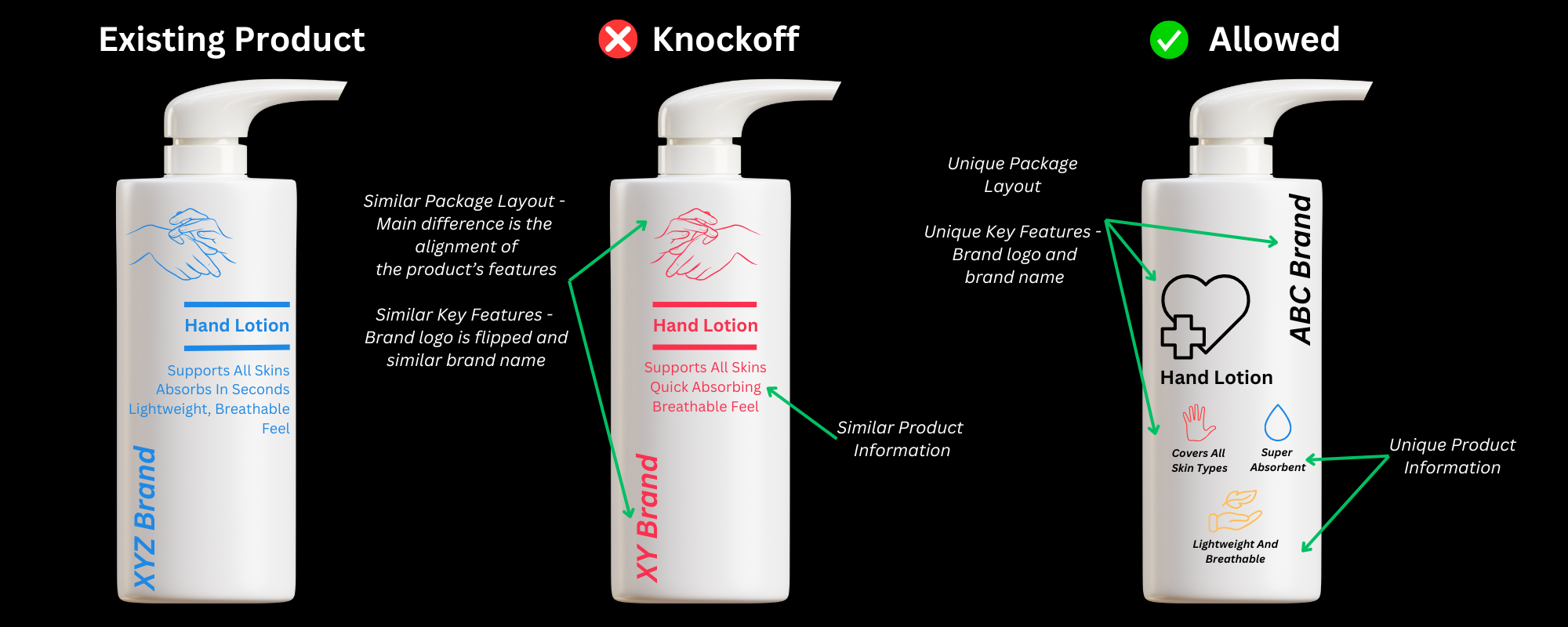
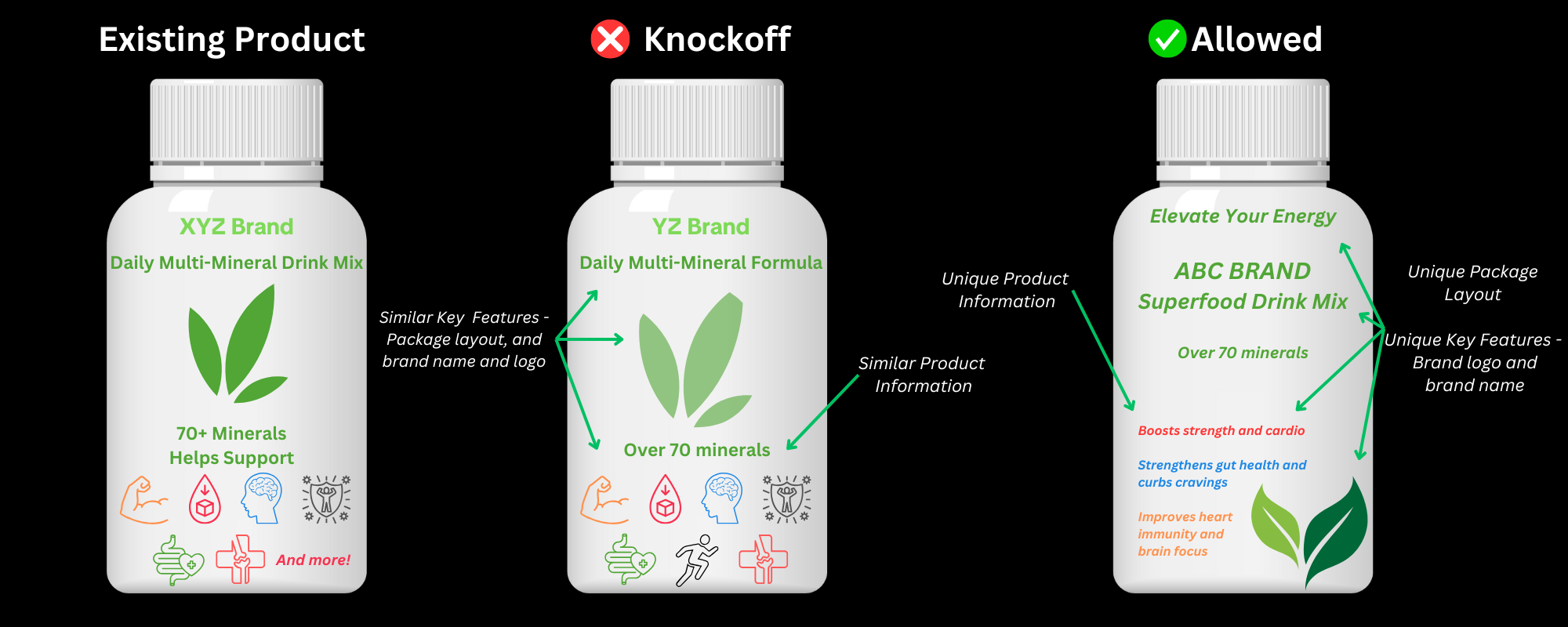
- If the product looks similar to a branded product or "copies" elements of its design, feel, or look, don't promote it. It could be a knockoff. Take note - not even a 50 to 60% similarity is allowed! Below are examples of knockoffs (which must not be promoted) and original products (which can be promoted):
What to Avoid🚫
- Don't use trademarks (e.g., brand names and logos) in your content without permission from their owner.
- Don't use someone's name, image, or likeness to promote a product without their permission.
- Don't promote products if obvious branding changes have been made to mask their similarity to actual branded products:
- Shortened or misspelt brand names
- Brand names with spaces added or removed
- Brand names with repeated characters
- Brand names with letters replaced with numbers or symbols
- Don't promote any product where the listing emphasizes its close similarity to an actual branded product.
- Promotional phrases that run foul of this rule include "inspired by X brand", "similar to", "as good as", "same features as", "it works the same as", "duplicate of", and "smells like".
- Avoid products with descriptive terms such as replica, forged, mirror, copy, alike, duplicate, dupe, clone, like the original, as the original, imitation, high imitation, 1:1, mirror quality, lushentic grade, and factory leakage.
- Don't use brand names in hashtags (e.g., "#brand") to increase traffic, especially in video content.
- Don't manipulate your videos using edits, effects, or filters to disguise copied or repetitive content.
Examples of Content That Does Not Infringe Others' Privacy and IP Rights
- Displaying a brand's name to highlight that your product works with or supports their products. Examples include charging cables and video game controllers.
- Mentioning another brand to compare it with your product.
Examples of Content Infringing Others' Privacy and IP Rights
- Using a celebrity's name to endorse a product without permission.
- Posting content of yourself wearing a tshirt with an athlete's name or face without permission.
- Claiming that another creator loves using a product, without permission.
- Livestreaming with the logo of a famous fast food chain in the background without permission.
- Including a screenshot of a customer's positive review in your content without permission.
- Displaying a brand's logo, while promoting a product, to suggest it is similar to the brand's product.
- Promoting an unbranded game console which contains pirated video games.
Unlock New Growth Through Promotional Content
Unlock new growth on TikTok Shop by creating content that is relevant, original, and valuable for your viewers. Align your content with the products you're promoting while showcasing your unique style and take your growth to the next level!Frequently Asked Questions
How can I tell if the content I want to use is copyrighted?
You should avoid using any content from movies, TV shows, or any other media created by others, as well as material sourced from other organizations or platforms. To avoid copyright issues, always create original content yourself.
What to do if someone else uses my content without my permission?
If you believe someone has used your content without permission, you can first contact the creator directly to resolve the matter. If that does not work, you may report this through TikTok Help Center. TikTok will review the case and take appropriate action to protect your content.
To make a report, navigate to the TikTok Shop tab in the bottom menu, select 'Help', then tap 'Chat with Us'.
To make a report, navigate to the TikTok Shop tab in the bottom menu, select 'Help', then tap 'Chat with Us'.
For more information, please refer to our TikTok Shop Content Policy.